top of page
Search

FVS Written Response to the USACE Miami-Dade Back Bay Phase II Draft Feasibility Report

Writer: Aaron DeMayo
Aaron DeMayo
2 days ago
2 min read

Future Vision Studios has followed the Miami-Dade Back Bay study from the start, attending most public meetings and participating at each stage. In 2020, FVS submitted written comments on the U.S. Army Corps of Engineers' Draft Feasibility Report. The study has since moved into its second phase, and FVS has again submitted comments, this time on the Phase II Draft Integrated Feasibility Report and Environmental Assessment. The public comment period closed September 18, 2026.


The Phase II plan proposes floodproofing and elevation for thousands of structures, and we fully support parts of it. Bringing federal investment to the region to harden critical infrastructure is especially important. We support the floodproofing of those facilities without reservation, since it fits the "multiple lines of defense" approach the Phase II report sets out. Federal funding to elevate private homes could also help many property owners. That part of the plan is complicated, though, and the letter raises substantial questions, including the participation assumptions and the treatment of voluntary acquisition. Even if the plan is fully implemented, most of the region's residual damage risk will remain.


The letter also credits the Corps' stated commitment to a more comprehensive study of large structural measures. It asks that the Final Report state that study's scoping schedule, its funding pathway, and whether authorization will be sought in WRDA 2028. For transparency, the full nineteen-page letter is included below.


Future Vision Studios' full comment letter:


Page 1 of 19: Cover of Future Vision Studios' written response to USACE on the Miami-Dade Back Bay study, over an aerial of the coastline.
Page 2 of 19: FVS letter to USACE Norfolk District, dated September 18, 2026, opening with FVS's introduction and statement of interest.
Page 3 of 19: FVS principles for coastal defense and Section 2, listing the parts of the Phase II plan that FVS supports.
Page 4 of 19: USACE public survey bar chart ranking adaptation measures, with mangrove restoration first and temporary flood panels last.
Page 5 of 19: Section 3 concerns: participation rates, slab-on-grade elevation limits, and voluntary acquisition as a near-term measure.
Page 6 of 19: Continued concerns on willing-seller acquisition, king tide flooding around raised homes, and permanent floodproofing.
Page 7 of 19: Section 4 on what the plan leaves unaddressed: excluded structures, compound flooding, life safety, and drainage.
Page 8 of 19: Drainage improvements left out of the screening table, and Section 5 on local adaptation work already underway.
Page 9 of 19: Map measuring seawall length in four Miami-Dade shoreline areas, showing the scale of privately held waterfront.
Page 10 of 19: The Coastline system map, showing tidal locks, land and water interventions, reef enhancement, and beach renourishment.
Page 11 of 19: Aerial map of proposed tidal lock locations from Brickell Bay north to the SE 17th Street Causeway in Broward County.

Page 12 of 19: Regional map of The Coastline intervention points, from Brickell Bay north to Broward County.
Page 13 of 19: Aerial diagrams of surge pathways converging on the Brickell and Brickell Key shoreline.
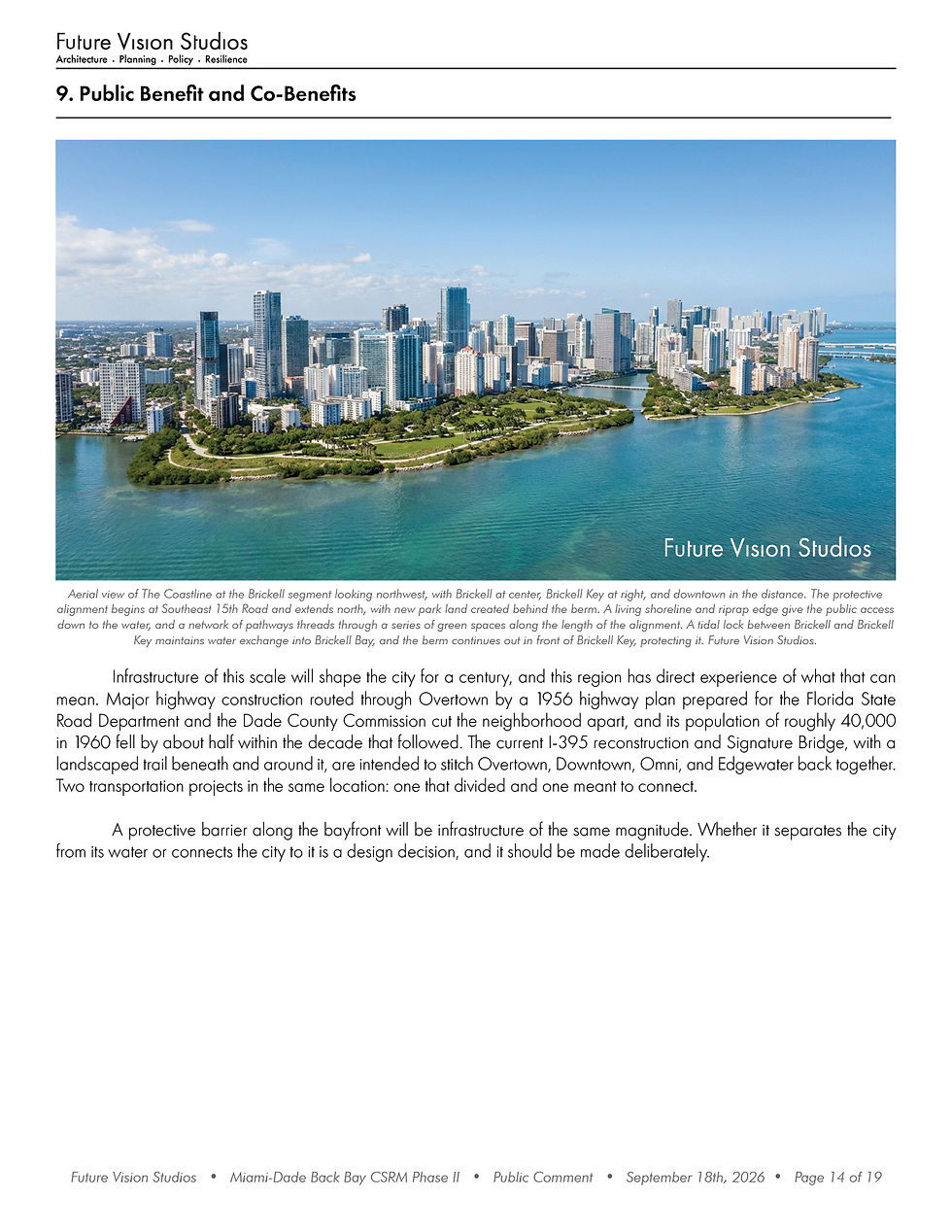
Page 14 of 19: Rendering of The Coastline at Brickell, with new parkland, a living shoreline, and a tidal lock at Brickell Key.
Page 15 of 19: Two renderings: tidal locks at Brickell Key, and a pedestrian bridge and island at the mouth of the Miami River.
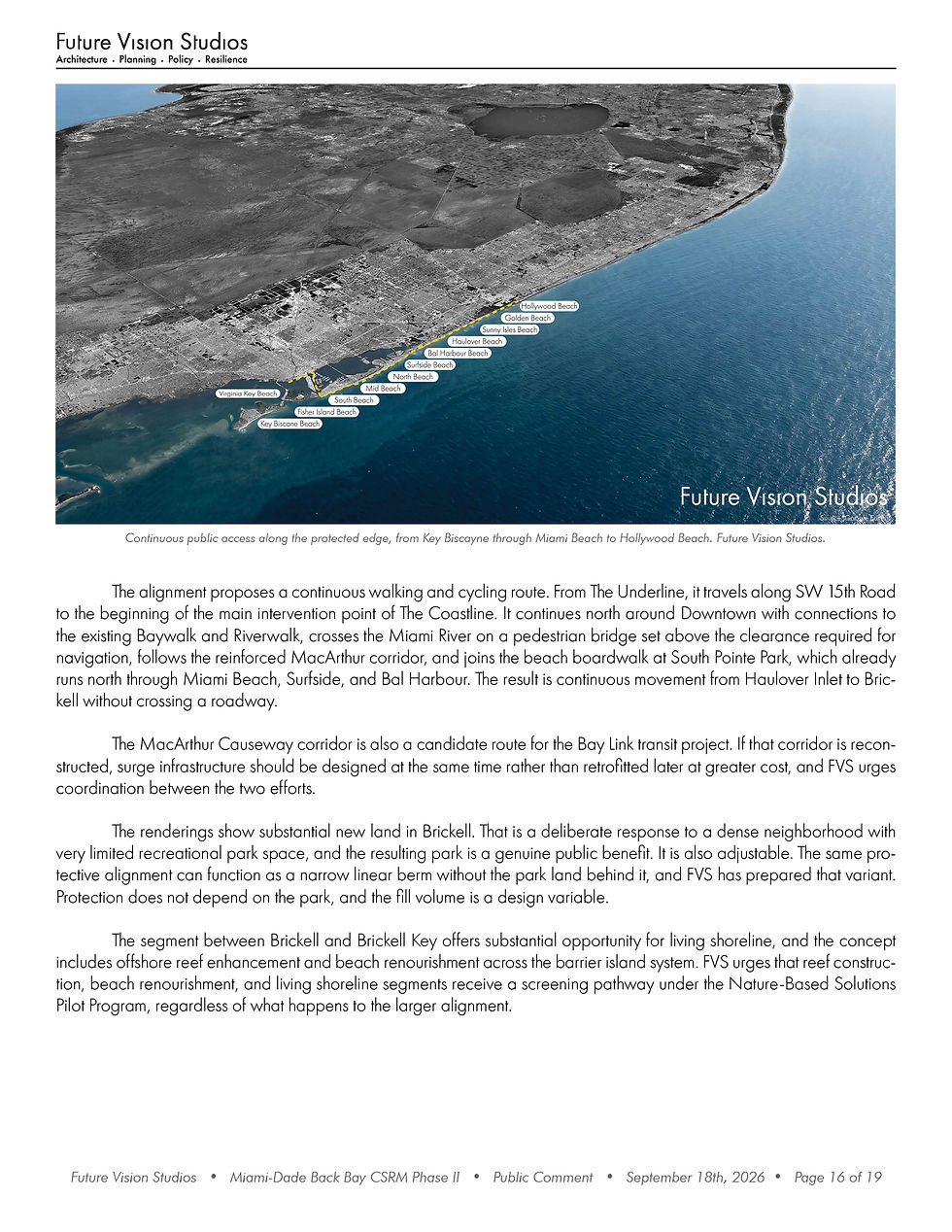
Page 16 of 19: Aerial map of continuous public access along the protected edge, from Key Biscayne to Hollywood Beach.
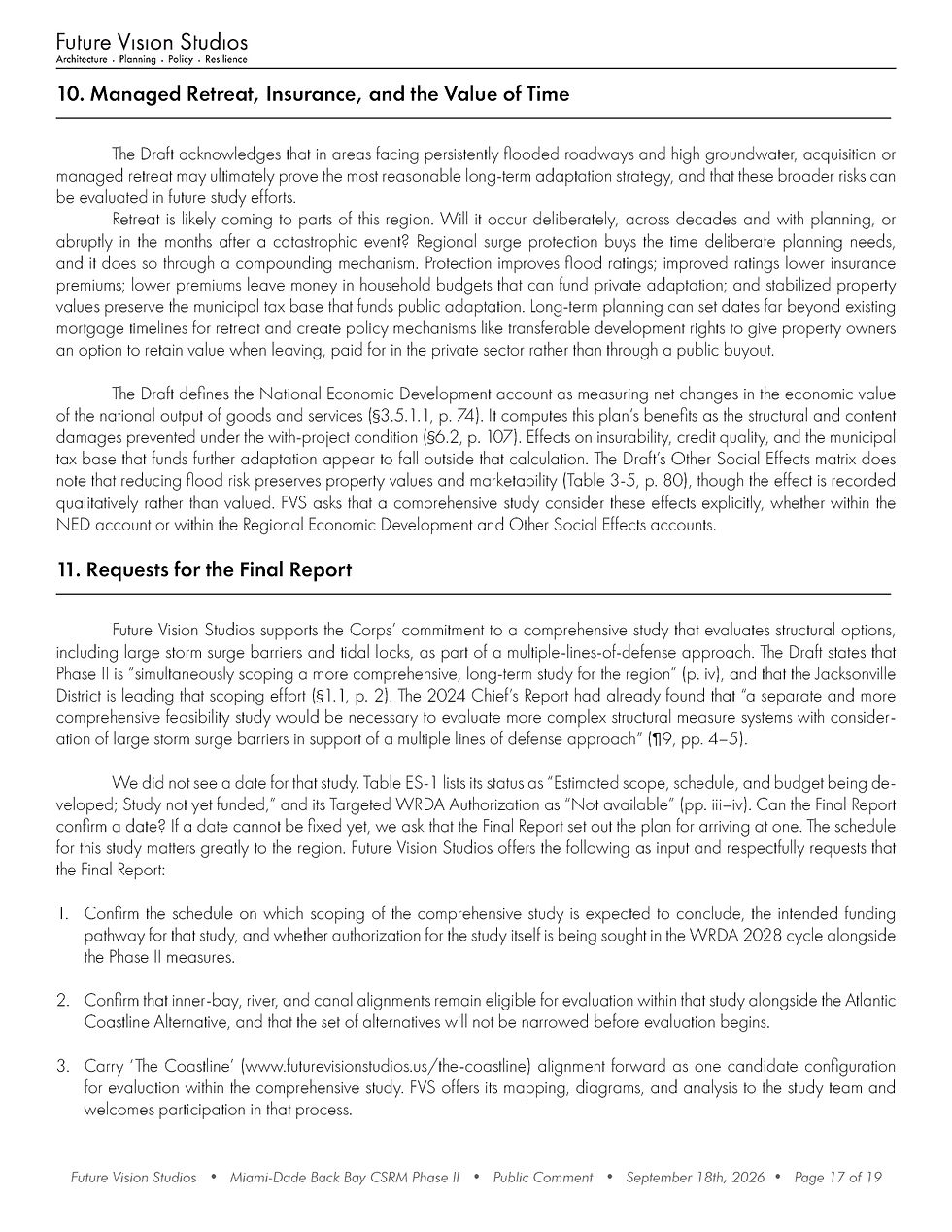
Page 17 of 19: Sections 10 and 11 on managed retreat and insurance, followed by FVS's requests for the Final Report.

Page 18 of 19: Continued list of requests for the Final Report, items 4 through 10.

Page 19 of 19: Closing statement and signature of Aaron DeMayo, Founder and Principal of Future Vision Studios.

The Comprehensive Study Ahead


Several of the letter's questions concern measures outside the current study's scope, including the large structural systems the Corps has identified for future study. The letter offers The Coastline, FVS's regional bay and river alignment first submitted to this study in 2020, as one candidate configuration for that evaluation. More on it is available here.


More information on the study is available on the USACE Miami-Dade Back Bay study page.


Thank you for reading. You can send questions and feedback through our contact page.


Comments


bottom of page